
How to Memorize Times Tables (The Calm Way That Sticks)
In this article
Short answer: Memorizing times tables goes fastest when you do less of it at once: a few minutes most days, a small handful of facts at a time, and games instead of speed drills. And the mountain is smaller than it looks — of the hundred squares on a 10-by-10 wall chart, only about twenty-one facts need real memory work. The rest come free with patterns your child probably already has.
We build a math app for young kids, and the recognizer that reads their handwritten answers has watched thousands of children work through multiplication rounds. The children who get comfortable are almost never the ones who drilled the longest. They are the ones who practiced briefly, often, and without anyone hovering with a stopwatch. This guide is that method, written down.
What “knowing” a times table really means
There is a difference between working out 6 times 7 and knowing it. Working it out — counting up in sixes, or reaching it from 6 times 6 plus one more 6 — is genuinely valuable, and it is where every child starts. Knowing it is when 42 arrives in about a second, without effort. Schools care about that recall for a practical reason: when the answer just appears, the child's working memory is free for the harder thing they are actually doing, like a word problem or long multiplication.
The route from working-out to knowing is not more pressure; it is more retrievals. Every time a child pulls a fact out of their own head, rather than reading it off a chart, that fact gets a little more permanent. This one idea — asking beats showing — powers everything below.
How many facts are there, really?
A wall chart looks like a hundred things to learn, which is exactly why it feels overwhelming pinned above a desk. Watch what happens when you take away everything your child gets for free:
| Take away… | Facts left |
|---|---|
| The full 10 × 10 wall chart | 100 |
| The 1s — anything times 1 is itself | 81 |
| The 10s — say the number, add a zero | 64 |
| Half the grid — 3 × 8 is the same fact as 8 × 3 | 36 |
| The 2s — they are doubles, and most kids own doubles | 28 |
| The 5s — the 5, 10, 15, 20 skip-count | 21 |
Twenty-one. That is the whole mountain: a core built from the 3s, 4s, 6s, 7s, 8s and 9s, and most of the truly stubborn ones cluster around 6 × 7, 7 × 8 and 8 × 8. Show your child this table — genuinely, sit down and show them. “You already own most of the chart” changes how the whole project feels before a single new fact is learned.
The five-minute routine that sticks
Here is the whole method. It takes about five minutes, works at breakfast or in the car, and needs nothing but your voice.
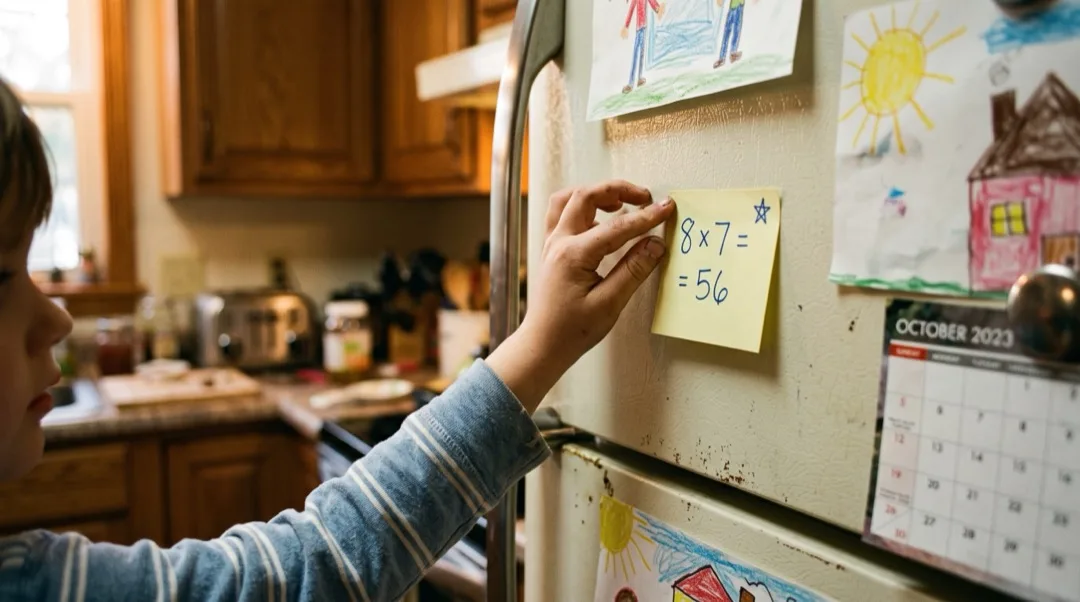
- Pick three facts for the week. Not a whole table — three facts, on a sticky note on the fridge. Next week, three more.
- Ask, don't show. Quiz them out loud, gently, and let the answer come from memory. Retrieval is the active ingredient; re-reading a chart is nearly useless by comparison.
- Mix in old facts. For every new fact, sprinkle in two they already know. The wins keep it fun, and revisiting is what stops forgetting.
- Let them work it out when they blank. “I don't know 6 × 7… but 6 × 6 is 36, plus 6 is 42.” That fallback is not cheating; it is the fact being built.
- Stop while it is still fun. Five minutes, then done, ideally on a win. Tomorrow beats more-today.
The order of tables matters less than people think, but there is a sensible sequence — 2s, 10s and 5s first, the hard 6s to 9s last. We cover it, along with what schools expect at each age, in when do kids learn times tables.
Tricks that earn their keep
Times-table tricks are everywhere, and most are more fun to watch than useful to own. Four genuinely earn their place:
- The 9s on fingers. Hold up all ten fingers and fold down the finger you are multiplying by — for 9 × 4, fold the fourth finger. Fingers left of the fold are tens (3), fingers right of it are ones (6): 36. Works for the whole 9s table.
- The 9s digit check. The digits of every 9s answer add up to nine — 18, 27, 36, 45 and so on — and the tens digit is one less than the number you multiplied by. Kids enjoy catching the pattern in the act.
- Doubling chains. The 4s are the 2s doubled; the 8s are the 4s doubled. A child who can double can reach a forgotten 8s fact in two calm steps.
- Squares as landmarks. 6 × 6, 7 × 7 and 8 × 8 form a diagonal of anchor points. From 7 × 7 = 49, the dreaded 7 × 8 is just one more 7.

Games that do the memorizing for you
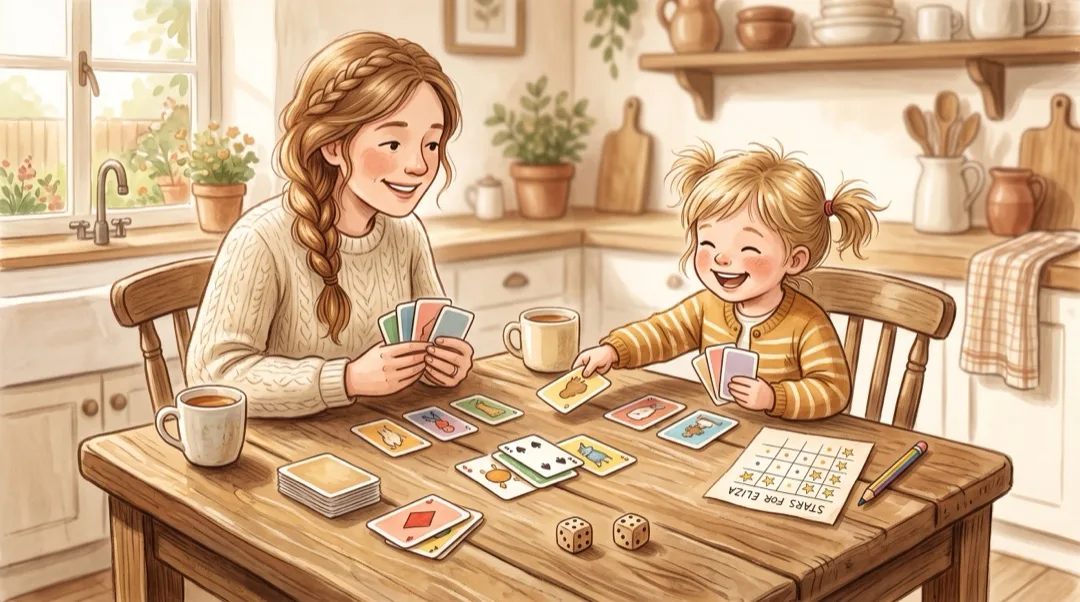
A deck of cards and a pair of dice cover most of it. Every one of these is retrieval practice wearing a costume:
- Multiplication war. Strip the face cards from a deck and split it. You each flip a card; first to say the product keeps both. If the skill gap is big, the grown-up answers only the hard half of the grid.
- Dice duel. Roll two dice, multiply, swap turns. Two dice cap at 6 × 6, which happens to be the gentle edge of the hard core — perfect for warming up.
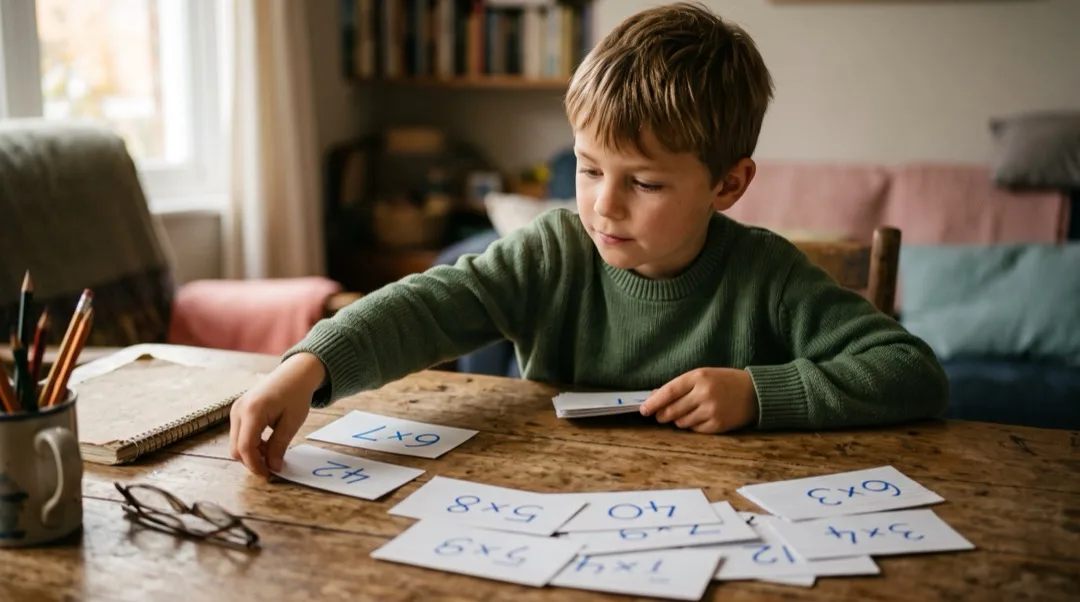
- Table snap. Facts on some index cards, answers on others; deal and match. Making the cards together quietly counts as a whole round of practice.
- Everyday multiplication. Egg boxes are the 6s, chair legs the 4s, fingers the 5s and 10s. One casual “how many wheels on those three cars?” in a car park is a retrieval too.
- Their score, not yours. Let them keep the tally and try to beat yesterday's score — their own, not a sibling's. Progress a child owns is the motivation that lasts.
Why speed drills backfire
Timed tests feel productive — they look like rigor. But for many children the clock changes the task: instead of remembering, they are managing fear. Stanford's math-education group youcubed has argued for years, in their paper “Fluency Without Fear”, that timed pressure is linked with math anxiety for some children, and that fluency grows out of understanding and use, not out of racing.
The practical version: speed is the result of knowing the facts well, not the method for learning them. Keep home practice untimed, let the child hold the cards, and if school runs timed checks — England's Year 4 multiplication check, for instance — treat home as the calm counterweight, the one place where 7 × 8 is allowed to take three seconds.
How long does it take?
Months, not days — and that is by design, not failure. England's curriculum gives children roughly three school years, from the first 2s, 5s and 10s in Year 2 to the full grid by the end of Year 4. With the five-minute routine, the easy half of the chart usually feels solid within a few weeks, and the hard core of twenty-one settles over a school term or two. Expect forgetting along the way: a fact learned last month will slip, and come back faster each time it does. That relearning loop is the memorizing.
If it is taking longer, more minutes per day is rarely the fix — try smaller batches, more days, more games. And if your child stays anxious or stuck on the same few facts for months, their teacher has seen the whole class and is the right first call.
Where our app fits, honestly
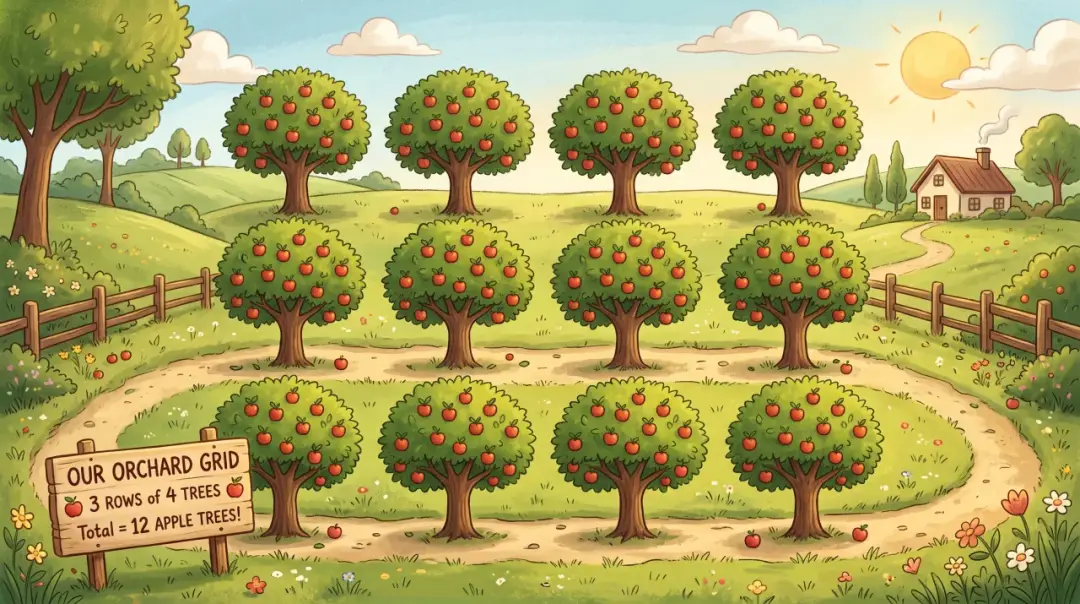
Our app, 99 Math Animals, is strongest on the step before the drilling: multiplication as equal groups — four baskets of three apples — which is what stops the times tables being a wall of arbitrary answers.
It has multiplication rounds children answer by writing the number with a finger, but it is not a 12-by-12 drilling machine, and everything in this guide works with no screen at all. If you are weighing apps for practice, our checklist for choosing a math app is deliberately hard on apps like ours, and ways to practice numbers at home covers the younger years this guide grows out of.
Questions parents ask
How long does it take to memorize times tables?
With a few minutes of practice most days, the easy tables (1s, 2s, 5s, 10s) usually feel solid within weeks, and the harder 6s to 9s settle over a school term or two. England's curriculum allows about three years for the full journey, so months of gradual progress is normal, not slow.
What is the fastest way to memorize times tables?
Short, daily retrieval practice — being asked and answering from memory — beats every shortcut. Three new facts a week, mixed with ones already known, inside games rather than drills. Tricks like the 9s finger trick help with specific tables, but no method skips the practice.
Are flashcards good for learning times tables?
Yes, used calmly: a small deck, no timer, and the child saying the answer before flipping the card. Flashcards work because they force retrieval. They stop working when they turn into a speed test, which for many children adds anxiety instead of fluency.
What age should a child know their times tables by?
It depends on the school system. England expects the full grid by the end of Year 4, around age 9, while US schools introduce multiplication in third grade and build fluency through grades 3 to 5. The age-by-age expectations are covered in when do kids learn times tables.