


How to Teach a Child to Count Money

In this article
- What age do kids learn to count money?
- Which coin should kids learn to count first?
- Why is the quarter so much harder than the other coins?
- Does it matter whether we practice with real coins or play money?
- What's a simple way to practice at home?
- My child can count pennies and nickels but gets stuck on dimes and quarters together — is that normal?
Most kids start identifying coins (penny, nickel, dime, quarter) around kindergarten, and start actually counting a mixed group of them — adding up their value, not just naming them — around 2nd grade, once skip counting is comfortable.
Short answer: counting money is really skip counting wearing a disguise. Pennies count by 1s, nickels by 5s, dimes by 10s — all patterns a child who can already skip count already half-knows — so teach coins in that order, using real coins over play money or worksheets, and expect the quarter to be the one that actually needs new work, since 25 doesn't follow a pattern the other three do.
We make a counting app built on the same skip-counting foundation coin-counting runs on, so money math is a skill we think about even though our app doesn't teach it directly. Below: the order that makes coins click fastest, why the quarter is genuinely the odd one out, and simple ways to practice with real change instead of worksheets.
What age do kids learn to count money?
In US elementary curricula, identifying coins by sight (penny, nickel, dime, quarter) is typically a kindergarten-to-1st-grade skill, while actually counting a mixed group of coins to find a total value — the harder skill — is usually 2nd grade (it's a named Common Core standard, 2.MD.C.8: solving word problems involving dollar bills, quarters, dimes, nickels, and pennies, using $ and ¢ symbols).
The gap between those two stages is normal, not a sign of falling behind — naming a coin and computing with it are genuinely different skills, the same split that shows up between recognizing a digit and doing arithmetic with it.
Which coin should kids learn to count first?
In the order that matches skip counting a child already knows, or is already learning:
| Coin | Value | Counts by |
|---|---|---|
| Penny | 1¢ | Ones — no new skill, just counting |
| Nickel | 5¢ | Fives — same pattern as skip counting by 5s |
| Dime | 10¢ | Tens — the easiest skip-count pattern there is |
| Quarter | 25¢ | Twenty-fives — doesn't match any skip-count a child already knows |
That's exactly why skip counting pays off here — a child who can already count 5, 10, 15, 20 has, without knowing it, already learned to count nickels. The dime is arguably even easier, since counting by 10s is usually the very first skip-counting pattern kids pick up.
Why is the quarter so much harder than the other coins?
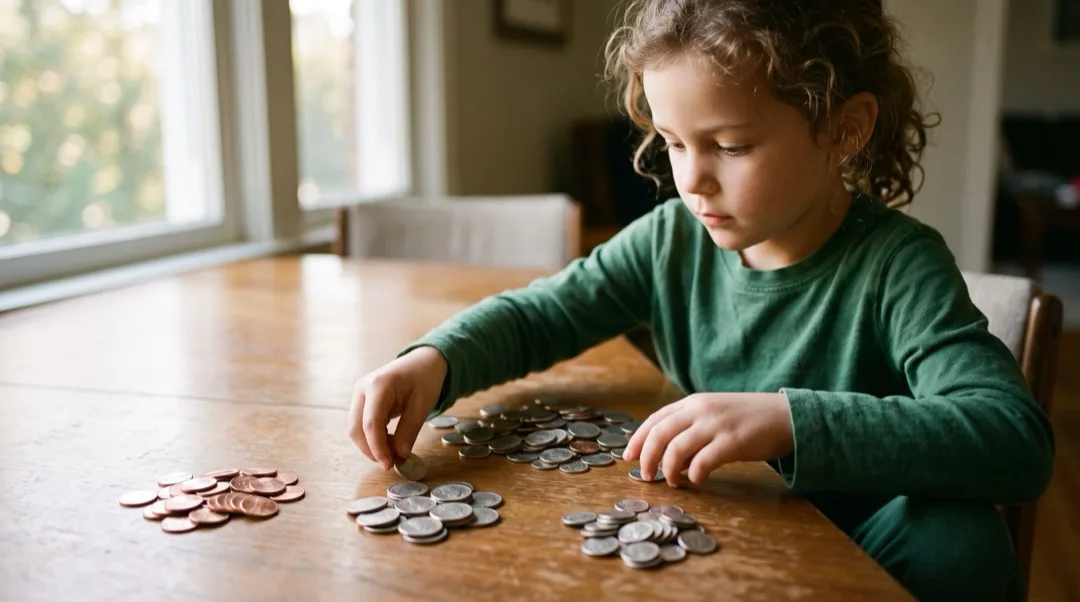
Because 25 doesn't follow a pattern a child already has. Pennies, nickels, and dimes all reuse skip-counting sequences (1s, 5s, 10s) a child is already building for other reasons; quarters don't reuse anything — 25, 50, 75, 100 is its own new sequence with no shortcut. It's worth naming that difference explicitly rather than expecting the quarter to click at the same speed as the other three just because they're all "just coins." Four quarters making exactly a dollar is usually the anchor that eventually makes the pattern stick, more than counting by 25s in the abstract.
Does it matter whether we practice with real coins or play money?
Real coins are worth the small hassle. Play-money sets are often too clean and uniform to force real attention — a child can start pattern-matching color and size instead of actually checking each coin. Real coins vary (different mint years, wear, the occasional oddly shiny one) in a way that keeps a child actually looking at the coin rather than the general shape of it. A handful of real change from a junk drawer or a parent's pocket works better than a boxed play-money set.
What's a simple way to practice at home?
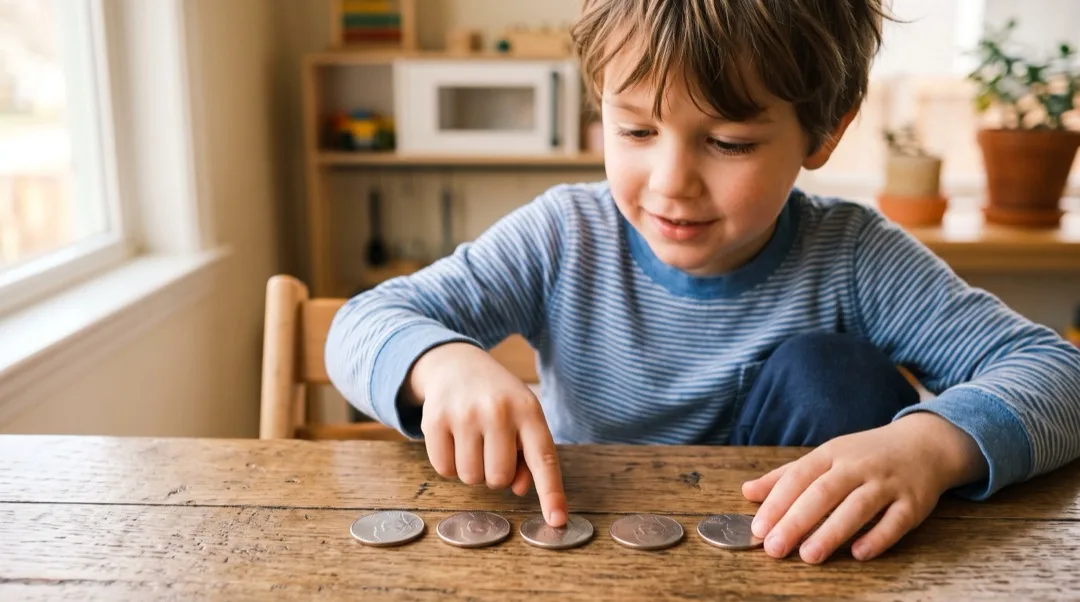
- Start with one coin type at a time. A pile of only nickels to skip count by 5s is much easier than a mixed pile — mixing coin types is a later step, not a starting point.
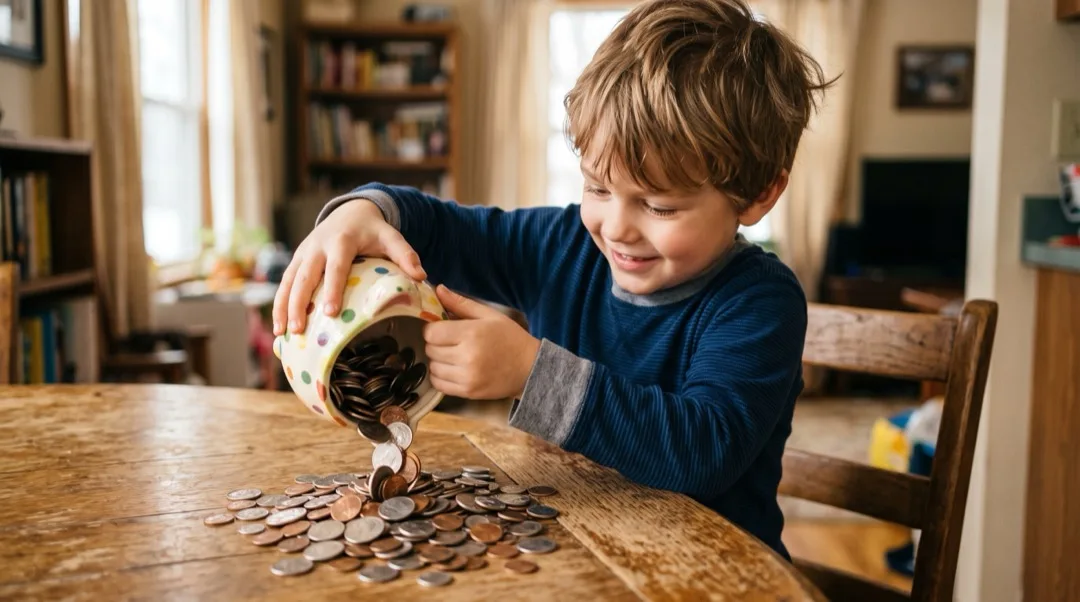
- Use a real coin jar or piggy bank, not a worksheet. Counting toward a small savings goal (a $2 toy, say) gives the counting an actual reason to happen, which sticks better than a printed sheet of coin drawings.
- Mix coin types only once each one is solid alone. A jar with pennies, nickels, and dimes together means switching skip-count patterns mid-count — a genuinely harder skill than counting any one pile, worth introducing on its own once each pile is easy separately.
My child can count pennies and nickels but gets stuck on dimes and quarters together — is that normal?
Yes. Combining coin types means switching between skip-counting patterns mid-count, which is a distinct, harder skill from counting any single pile well — not a sign that the dime or quarter individually hasn't been learned. Solid separately, shaky combined is the expected middle of this skill, not a gap.
Questions parents ask
What age do kids learn to count money?
Identifying coins by sight is usually a kindergarten-to-1st-grade skill; actually counting a mixed group of coins to find a total value is usually 2nd grade in US curricula (Common Core standard 2.MD.C.8). The gap between naming a coin and computing with it is normal, not a delay.
What order should kids learn coins in?
Pennies first (counting by 1s), then nickels (counting by 5s), then dimes (counting by 10s) — all patterns that match skip counting a child is already building. Quarters come last since counting by 25s doesn't reuse any pattern the other three do.
Why is counting quarters harder than other coins?
Because 25 isn't a skip-counting pattern most kids already have, unlike 1s, 5s, and 10s for pennies, nickels, and dimes. Four quarters making exactly a dollar is usually the anchor that eventually makes the pattern click.
How does skip counting help with counting money?
Directly — nickels count by 5s and dimes count by 10s, the exact same sequences used in skip counting blocks or steps. A child who can already skip count by 5s and 10s has effectively already learned to count nickels and dimes, just in a new context.