
When Do Kids Learn Addition and Subtraction? Ages & Stages
In this article
Short answer: Most children start adding and subtracting with real things — crackers, fingers, toy cars — somewhere around ages 4 to 5, manage small sums on fingers by about 6, and can do simple math in their heads around 7 to 8. Subtraction runs a little behind addition the whole way, which is normal: taking away is simply harder to see than putting together.
As with every milestone we write about, the ranges are wide and the edges are soft. We make a counting app for young kids and watch thousands of children cross this exact bridge — from counting things to combining them — and the crossing is gradual everywhere: a child who adds 3 and 2 confidently at the snack table may shrug at the same sum spoken out loud. Both facts are true at once, and both are fine.
What age do kids learn addition and subtraction?
School systems put formal addition in roughly the same window. In the US, kindergarten standards expect fluent adding and subtracting within 5 by the end of kindergarten (age 6), within 10 in first grade, and from-memory fluency within 20 by the end of second grade (around 8). In England, the national curriculum has Year 1 children (5 to 6) working with number bonds and sums within 20, with fluent recall of bonds to 20 expected in Year 2. England starts younger; the destination is the same.
| Around age | What most kids do | US school | England |
|---|---|---|---|
| 4–5 | Combines and shares real objects | Pre-K play | Reception, bonds to 5 |
| 5–6 | Adds within 5–10 on fingers | K: within 5 | Year 1, within 20 |
| 6–7 | Uses strategies within 10–20 | Grade 1: within 10 | Year 2, fluent bonds |
| 7–8 | Knows small sums from memory | Grade 2: within 20 | Year 3 builds on it |
The three stages: counting all, counting on, just knowing
Under the hood, every child climbs the same three steps. First comes counting all: for 3 + 2 they count "one, two, three" then "four, five" — every single item, every time. Later comes counting on: they hold the 3 in their head and just say "four, five" — and the really elegant version starts from the *bigger* number. Finally comes just knowing: 3 + 2 is 5 the way their own name is their name, no counting involved.
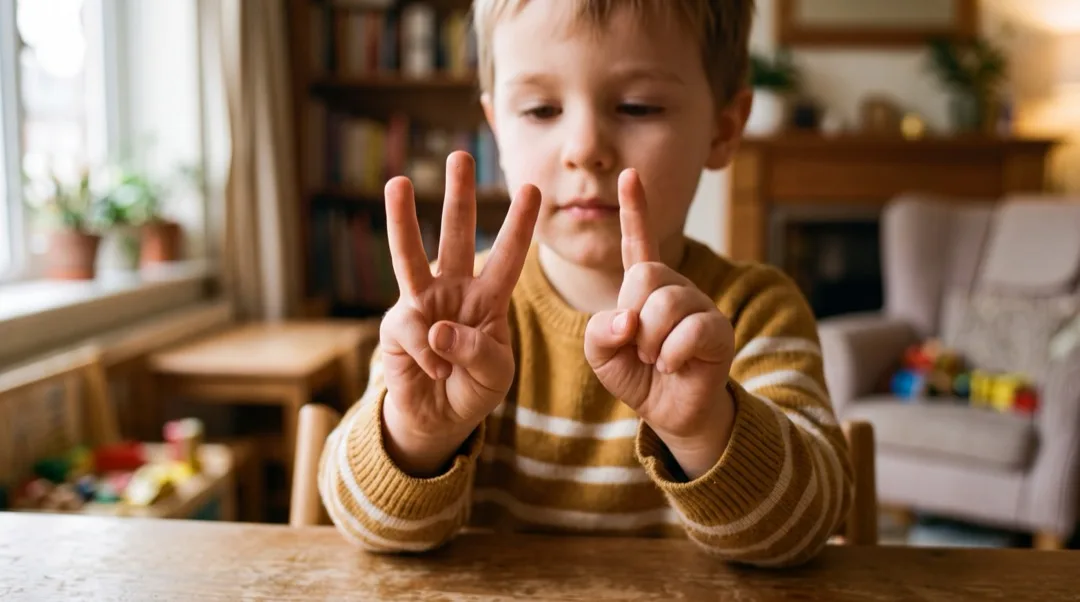
The stages matter because they tell you what "help" looks like. A child counting all does not need flashcards; they need lots of small, real sums until counting on shows up by itself. A child counting on does not need speed; they need the patterns below to start turning strategies into memories. Pushing a stage early tends to add tears, not months.
Number bonds, explained for parents
If your child's school talks about number bonds, it means the pairs that make a number: 7 + 3, 6 + 4 and 5 + 5 are all bonds of 10. Teachers are slightly obsessed with them for a good reason — bonds are the skeleton of mental math. A child who owns the bonds of 10 can split any awkward sum through 10: for 8 + 5 they quietly do 8 + 2, then 3 more, and land on 13 without ever "memorizing" 8 + 5 itself.

You do not need worksheets to practice bonds. An egg carton is a ready-made bonds quiz: put some eggs in, ask how many are missing. Ten fingers work the same way — hold some down, how many are up? Doubles (2 + 2, 3 + 3, 4 + 4) are usually the first facts children just *know*, and they are worth celebrating when they arrive, because near-doubles ("3 + 4 is double 3 and one more") follow right behind.
Fingers are fine
A quick reassurance, because it is the question parents whisper: yes, counting on fingers is fine — at this age it is a *good* sign, not a bad one. Fingers are a portable number line, and children abandon them naturally as facts move into memory, the same way training wheels come off. Shaming finger-counting mostly teaches a child to hide their hands under the table, which slows the very recall it was supposed to speed up.
Signs it is clicking
- They count on from the bigger number. Given 2 + 7, they start at 7 — quiet evidence of real understanding.
- Doubles arrive. 3 + 3 and 5 + 5 come back instantly, and near-doubles lean on them.
- They split through ten. 9 + 4 becomes "9 + 1 and 3 more" — the bonds are working.
- Subtraction turns into counting up. For 11 − 8 they climb from 8 to 11 rather than counting backwards, which is the strategy adults use with change.
- They catch nonsense. Tell them 4 + 3 is 9 and they laugh at you. Estimation and number sense are growing under the arithmetic.
Helping at home, without worksheets
Everything a five- or six-year-old needs lives in games and food. A few minutes of any of these beats a drill sheet:
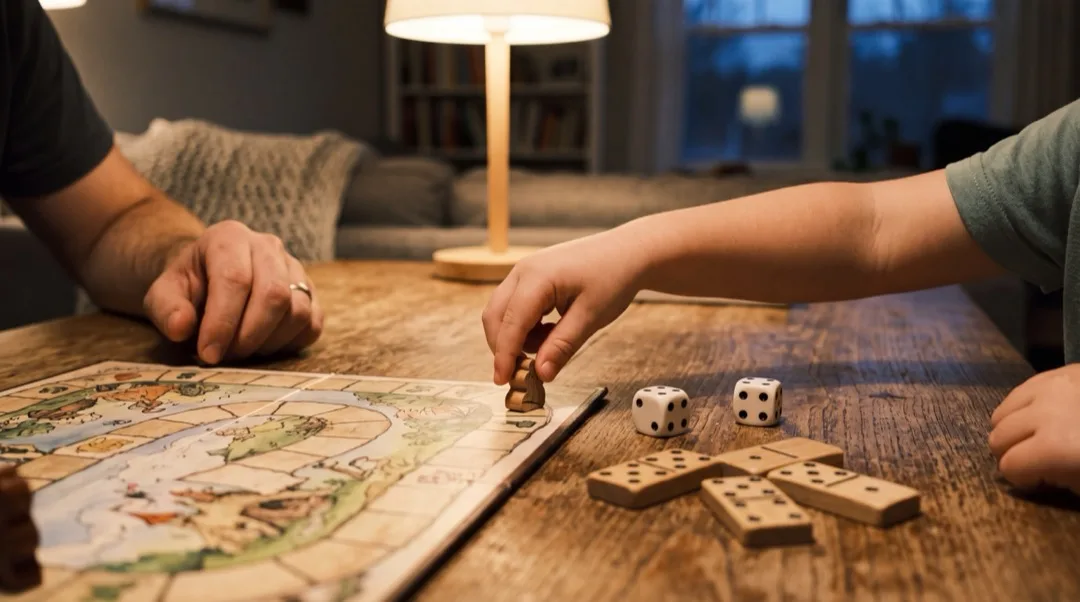
- Board games with dice. Snakes and ladders is secretly an adding machine: roll, count on, move. Two dice, and suddenly they are adding pairs every turn.
- Dominoes. Each tile is a tiny sum waiting to be said out loud.
- Shop. Price the toys 1 to 5 coins, hand over a mixed fistful, make them give change. Subtraction with a plot.
- Snack math. "You have four crackers, I am stealing one — how many left?" Outrage is an excellent memory aid.
- The egg-box quiz from above, two minutes while the pasta boils.
Where our app fits, honestly
Our app, 99 Math Animals, lives on exactly this bridge: children count groups of animals, then meet small additions and subtractions and write the answer by hand. The handwriting part is deliberate — saying "five" and writing 5 are different muscles, and schools want both. But an app is a supplement here, not the main course: the counting-on moment usually happens at a table, with real things and a patient adult. If you are picking any app for this stage, our honest checklist applies, and the no-screen ideas live in ways to practice numbers at home.
For the wider map — what comes before this and what comes after — see what math a 5-year-old should know, when kids learn to count to 100, and the road into times tables.
Questions parents ask
When should a child know addition facts by heart?
From-memory fluency within 20 is a second-grade expectation in the US (around age 8) and a Year 2 goal in England (age 7). Before that, counting on fingers or objects is the expected method, not a shortcut to wean off early.
What are number bonds?
The pairs that make a number: 7 + 3, 6 + 4 and 5 + 5 are bonds of 10. Schools drill them because they power mental math — a child who knows the bonds of 10 can split any sum through ten, like turning 8 + 5 into 8 + 2 and 3 more.
Should my 5-year-old be doing addition worksheets?
They do not need to. At five, adding real objects in play — snacks, dice, board games — builds the same skill with none of the tears. If your child enjoys worksheets, fine; if they refuse them, the dice game is teaching the identical math.
When do kids do mental math?
Simple sums start moving into the head around 6 to 7, usually via strategies like counting on and doubles, and settle into from-memory recall around 7 to 8. A child who still uses fingers at six is squarely inside the normal range.