



Making Ten: Why Your Child's School Teaches 8 + 5 as 8 + 2 + 3
In this article
- What is the making ten strategy?
- Why don't schools just teach kids to count on?
- What does a child need to know before making ten?
- When do kids learn to add across ten?
- How can I help my child practise making ten at home?
- My child already knows 8 + 5 = 13. Do they still have to draw the split?
- What about subtraction, like 13 − 5?
- What if making ten just doesn't click?
- Where does a math app fit?
Because 8 + 2 + 3 is how you get to 13 without counting. When your child's school writes 8 + 5 as 8 + 2 + 3, it is teaching one move: fill the bigger number up to ten, then add what is left. Eight and two make ten, ten and three make thirteen. Teachers call it making ten or bridging through ten, and it is the same thing most adults do in their heads when they work out 38 + 5.
Short answer: making ten splits the smaller number so the bigger one reaches 10: 8 + 5 becomes 8 + 2 + 3, which is 10 + 3, which is 13. Schools teach it in first grade (ages 6–7) because counting on gets slow and error-prone once a sum crosses ten. It only works when a child already knows the pairs that make 10 by heart, so that is what to practise first. The drawn branches and circles are scaffolding, and they fade.
If the homework sheet left you puzzled, you are in large company. In the US the method gets blamed on Common Core; in Japan, where the drawing is called the "cherry method", parents argue about it online. Below: what the method is, why schools bother with it, what has to come first, how to practise at home without teaching it "your way", and what to do when your child already knows the answer and does not want to draw the cherries.
What is the making ten strategy?
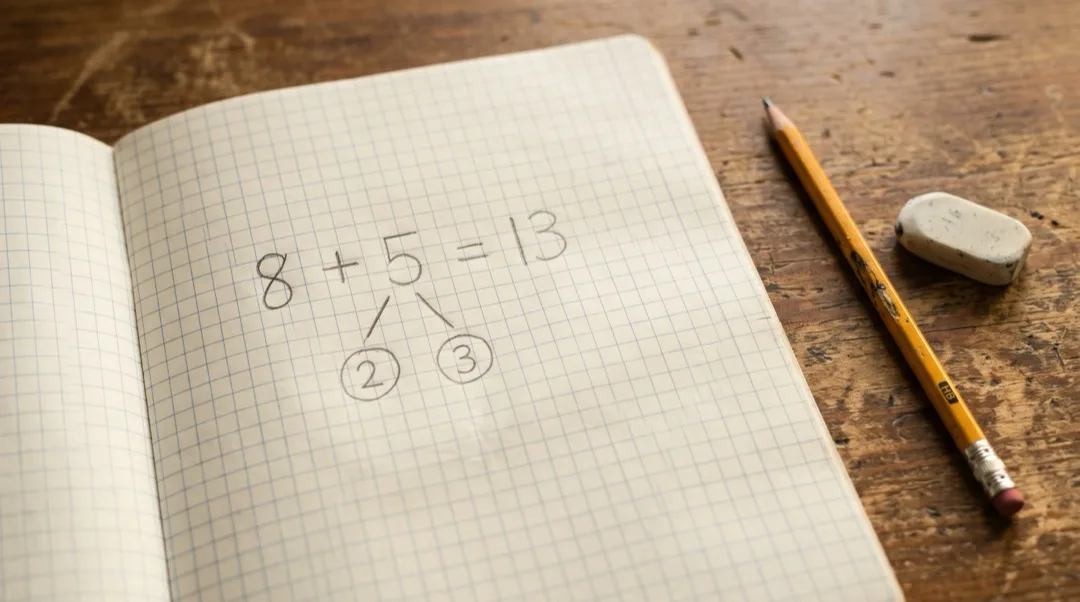
It turns one hard sum into two easy ones. Take 8 + 5:
- Ask the bigger number what it needs. 8 needs 2 more to make 10.
- Take that from the other number. 5 is 2 and 3.
- Fill the ten, then add the rest. 8 + 2 = 10, and 10 + 3 = 13.
Children usually write the split under the second number: two short lines from the 5 down to a 2 and a 3. In the US and Singapore this little picture is a number bond; in Japan the two circles hanging from their lines look like a pair of cherries, hence the name. Either way it is the child's working made visible, not a new kind of arithmetic.
Why ten, of all numbers? Because after ten our number system starts again: 13 is ten and three, 17 is ten and seven. Once a sum lands on ten, the rest is just reading a teen number. Chinese, Japanese and Korean say this out loud: thirteen is literally "ten-three" in all three languages. English hides it behind "thirteen", which is one reason English-speaking children often need a little more help seeing that 13 is a ten and three ones (our guide to place value has more on that).
Why don't schools just teach kids to count on?
They do, first. Counting on, saying "eight" and then counting five more ("nine, ten, eleven, twelve, thirteen"), is a real strategy and a sign of progress, because the child no longer counts both groups from one. It is normal at 5 and 6, and counting on fingers is not a bad habit.
The trouble starts when the numbers grow. Counting on two is easy; counting on seven or eight means keeping track of the count and the steps at the same time, and the classic slip is starting at the first number ("eight, nine, ten...") and landing one short. Making ten replaces the long count with two facts the child already owns: a pair that makes 10 and a teen number. And it keeps working later: 38 + 5 is 38 + 2 + 3, 47 + 6 is 47 + 3 + 3, and the same idea runs backwards for subtraction.
None of this is a fad. The US Common Core standards name the strategy in first grade with almost exactly this example (8 + 6 = 8 + 2 + 4 = 10 + 4 = 14). England's national curriculum builds Year 1 and Year 2 around number bonds, and schools in Japan, China, Korea and Singapore have taught it to six-year-olds for decades.
What does a child need to know before making ten?
Three things. If one of them is shaky, the method feels like a trick instead of a shortcut:
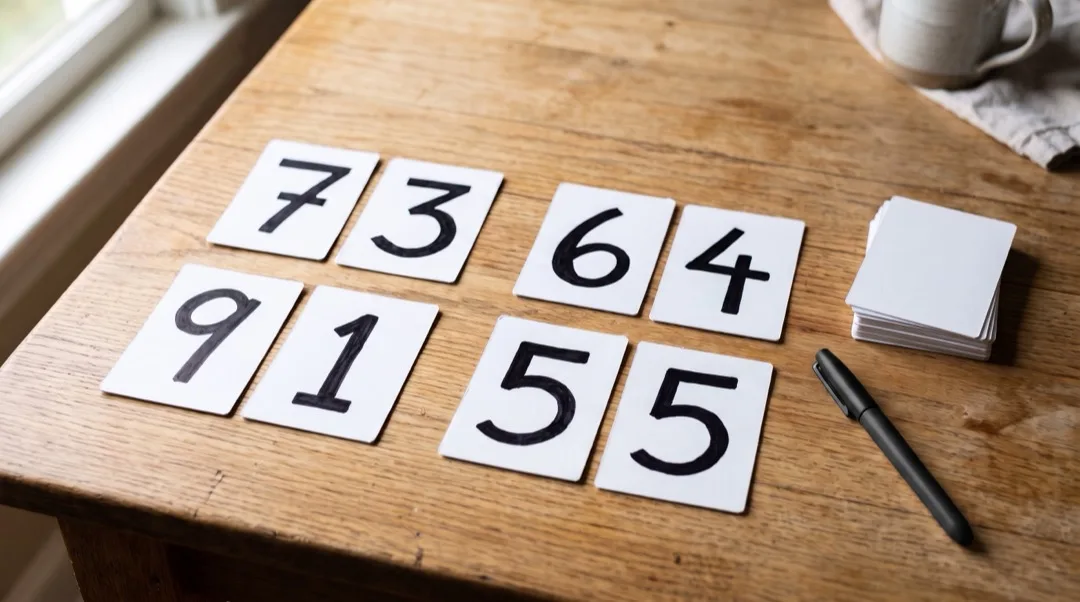
- The pairs that make 10, without counting. 9 and 1, 8 and 2, 7 and 3, 6 and 4, 5 and 5. This is the big one: a child who has to count to find what 8 needs gains nothing from the method.
- Splitting small numbers. 5 is 2 and 3, or 4 and 1; 6 is 3 and 3, or 2 and 4. Schools practise this with "number houses", dominoes and dot pictures.
- Ten and some more. 10 + 3 is 13 straight away, with no counting. If your child still counts on from ten, the teen numbers need a little more time first.
Most children work on these in kindergarten (Reception in England) and early first grade. If your child gets stuck on making ten, the fix is almost always one step back, not more of the same sums.
When do kids learn to add across ten?
Almost everywhere in the same window: pairs to 10 at 5 to 6, adding across ten in the first year of school, and quick recall of sums within 20 by about 8. The names differ more than the ages:
| Country | What it is called | When (roughly) |
|---|---|---|
| United States | Making ten, number bonds | Pairs to 10 in kindergarten; making ten in grade 1 (ages 6–7); sums within 20 from memory by the end of grade 2 |
| England | Number bonds, bridging through 10 | Some bonds to 10 by the end of Reception; bonds within 20 in Year 1 (ages 5–6); fluent to 20 in Year 2 |
| Singapore | Number bonds | Primary 1 (age 7) |
| Japan | Sakuranbo keisan, "cherry calculation" | Grade 1, second term (ages 6–7) |
| China | Còu shí fǎ, "the make-ten method" | Grade 1, first term (ages 6–7) |
| Germany | Zehnerübergang, "crossing the ten" | Grade 1 (ages 6–7) |
If your child is a few months behind the row for your country, that is ordinary. Most classrooms start with sums like 9 + 4, because 9 needs only one more, then move to 8 and 7, and leave sums like 6 + 7, where both numbers are close, until last.
How can I help my child practise making ten at home?
Five minutes here and there beats a page of sums. Some ideas, roughly in order:
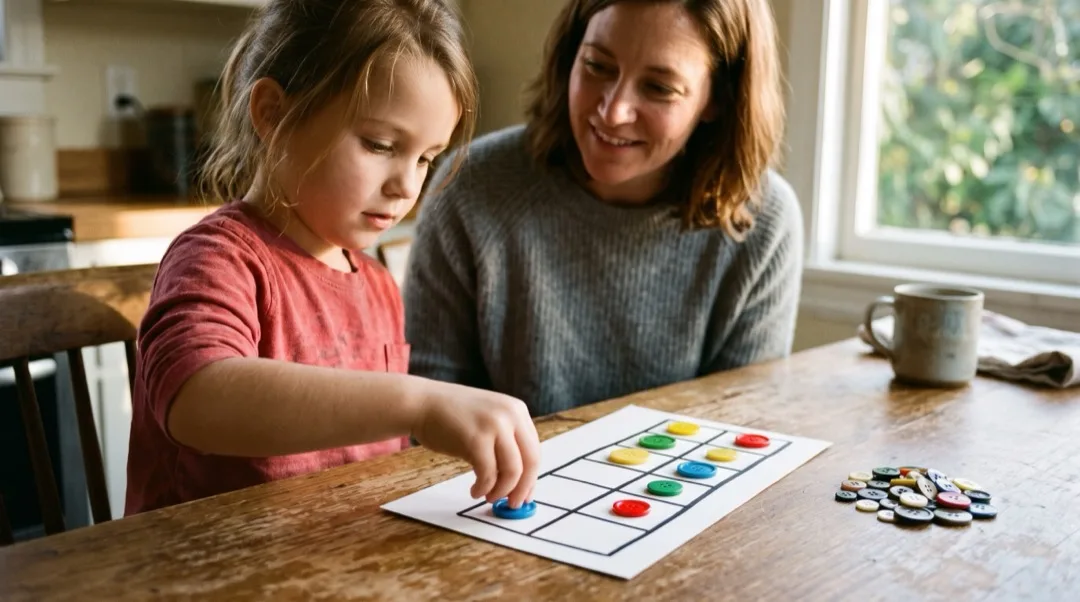
- Draw a ten frame. Two rows of five squares on a piece of card, and a handful of buttons. Put in 8: "How many squares are empty?" Then add 5 buttons one at a time: "Fill the frame first. How many went in? How many are left outside?" Ten and three is thirteen, and your child can see it.
- Use fingers. "Show me 7 fingers. How many are down?" Ten fingers are a ten frame that never gets lost.
- Play make-ten. A memory or go-fish game where a pair is two cards that make 10. Take the picture cards out of an ordinary deck and count the ace as 1.
- Ask the car question. "I'm thinking of 6. How many more to make 10?" It takes ten seconds and works anywhere.
- Only then, sums across ten. Start with 9 + something (9 needs just 1), then 8 + something, then 7 + something. Say the steps out loud together the first few times: "8 needs 2. 5 is 2 and 3. 10 and 3 is 13."
One thing to avoid: teaching a different method on top of the school's. If your child is learning to split the second number and you show them the way you were taught, they end up with two half-learned methods instead of one. Ask your child to teach you their way instead. It is the best check of whether they understand it, and children love being the teacher.
My child already knows 8 + 5 = 13. Do they still have to draw the split?
This is the question that starts the arguments. In Japan, parents regularly share tests where a correct answer was marked down because the cherries were missing, and the reaction is always the same: if the child knows the answer, why draw anything?
The honest middle is this. While a class is learning the method, the teacher wants to see it, for the same reason a later teacher asks for working in long division: the drawing shows how a child thinks, and it is the only way to spot a child who got the answer by counting and does not yet see the ten. Once a child knows a sum by heart, that is the goal. Making ten was always a route to quick facts, never a replacement for them.
So ask the teacher what they want on tests, tell your child that "the drawing shows the teacher how you thought", and do not worry when the drawings disappear from their notebooks during second grade. That is what is supposed to happen.
What about subtraction, like 13 − 5?
The same ten, used backwards. There are two common ways, and both are correct:
- Down to ten, then the rest. 13 − 3 = 10, then 2 more: 10 − 2 = 8. The 5 is split into the 3 that gets you to ten and the 2 left over. This is the version in the US standards (13 − 4 = 13 − 3 − 1).
- Take it from the ten. 13 is 10 and 3. Take the 5 from the 10, which leaves 5, then add the 3 back: 8. Japanese classrooms usually start with this one, because it needs nothing but the pairs that make 10.
Follow whichever your child's school uses, so they hear one way of talking about it. And the oldest trick still works: 13 − 5 is the same question as "5 and what make 13?"
What if making ten just doesn't click?
Give it time and look one step back. Most of the time a child who struggles with making ten does not yet know the pairs to 10 without counting, or still counts on from ten to reach 13. A week of card games on the pairs usually does more than another worksheet of sums across ten.
If your child is 7 or 8, has had plenty of relaxed practice and still counts every sum from one, or cannot tell which of two numbers is bigger, mention it to their teacher. Our article on struggling with math or dyscalculia explains what teachers look for, without the alarm.
Where does a math app fit?
Ours practises the pieces that come before making ten: counting, reading numbers and simple adding with animals. It does not teach the split itself, and we would rather your child learned that from a teacher and from you, with buttons on a table. If an app helps on a car journey, good. The ten frame on the kitchen table is still the better teacher.
Questions parents ask
What is the making ten strategy in math?
It is a way to add across ten by filling up to 10 first. For 8 + 5, the 5 is split into 2 and 3: 8 + 2 = 10, then 10 + 3 = 13. It replaces a long count with a pair that makes 10 and a teen number.
Why do schools teach 8 + 5 as 8 + 2 + 3?
Because counting on gets slow and error-prone once a sum crosses ten, and the same idea later works for bigger numbers (38 + 5 = 38 + 2 + 3) and for subtraction. It is taught in first grade in the US and in most other countries, not only under Common Core.
At what age do kids learn to add across ten?
Usually in the first year of school, around 6 to 7. The pairs that make 10 come first, often in kindergarten, and quick recall of all sums within 20 is expected by about 8.
Does my child have to draw the number bond if they know the answer?
While the class is learning the method, teachers often want to see it, because it shows how a child got the answer. Once your child knows a sum by heart, that is the goal. Ask the teacher what they expect on tests.