
What Math Should a 5-Year-Old Know? (And What Can Wait)
In this article
- The honest answer: ranges, not checklists
- Counting: what five usually looks like
- Recognizing and writing digits
- More, fewer, the same: comparing
- Shapes, patterns and the rest of it
- Milestones at 4, 5 and 6 — one honest table
- What NOT to worry about at five
- When it is worth asking someone
- Where our app fits, honestly
Short answer: Around age five, most children can say numbers to somewhere between 10 and 20, count a small pile of things one by one, recognize many of the digits 0 to 9, and tell you which plate has more crackers. Some do far more, some less, and at this age both are usually fine. If you searched this because a checklist made your stomach drop, start with that sentence.
We build a counting app for young kids, so we watch a lot of five-year-olds meet numbers. The honest thing we can report is the spread: two children the same age, both perfectly on track, can be a full year apart in what they do with numbers. Below is what age five usually looks like skill by skill, a table for ages 4 to 6, and — just as useful — the list of things that are not worth worrying about yet.
The honest answer: ranges, not checklists
Most "kindergarten readiness" checklists are written by people with something to sell, and they read like job requirements. Real curricula are gentler than the checklists quoting them. In the US, kindergarten standards treat the year itself as the time to learn counting to 100, writing numbers and tiny sums — that is the *output* of kindergarten, not the entry ticket. England's early-years goals for ages 4 to 5 focus on a deep, comfortable understanding of numbers just up to 10. Nobody serious expects arithmetic from a child starting school.
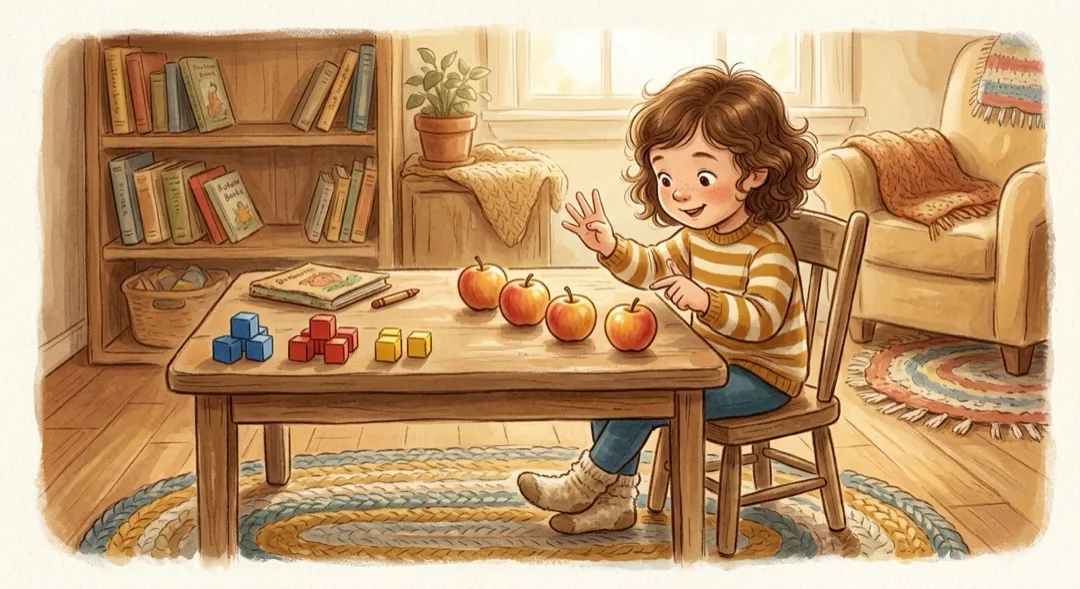
What actually matters at five is smaller and friendlier: an interest in counting things, a handful of core ideas, and hands that are starting to control a crayon. Everything else grows out of those.
Counting: what five usually looks like
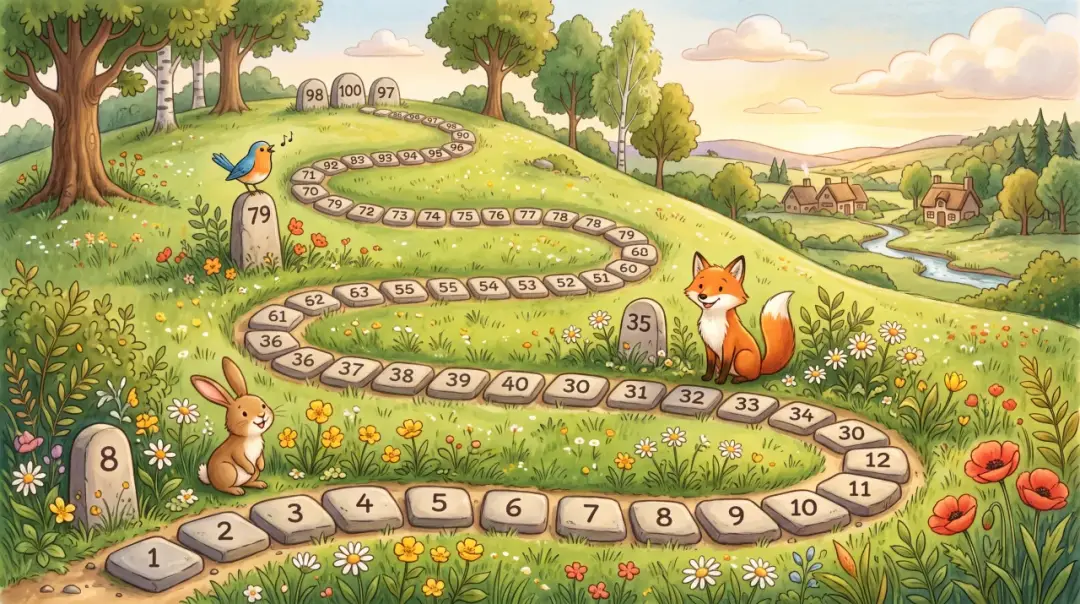
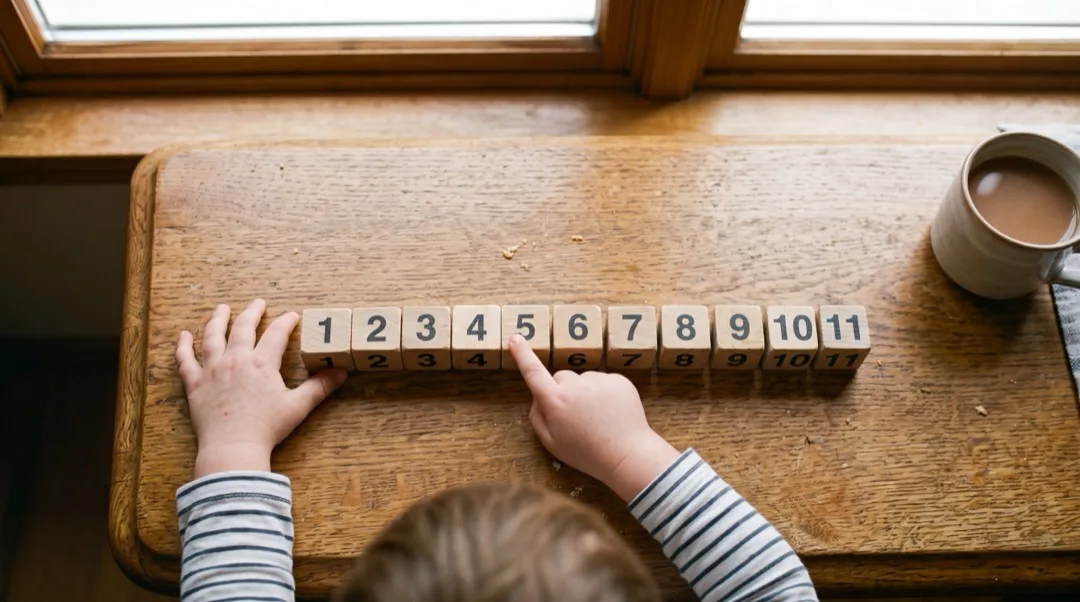
There are really two skills hiding in the word "counting". Saying the number words in order — the counting song — usually reaches 10 to 20 by five, with the teens still slippery ("thirteen, fourteen, sixteen…" is a classic and it is fine). Counting *things* is the deeper skill: touching each object once, saying one number per touch, and knowing the last number said is how many there are. By five, many children do this reliably up to about 10.

The long road from ten to a hundred, with its decade jumps and teen-number traps, has its own timeline — we wrote it up in when do kids learn to count to 100. Short version: reciting to 100 clicks around six, and understanding follows later still.
Recognizing and writing digits
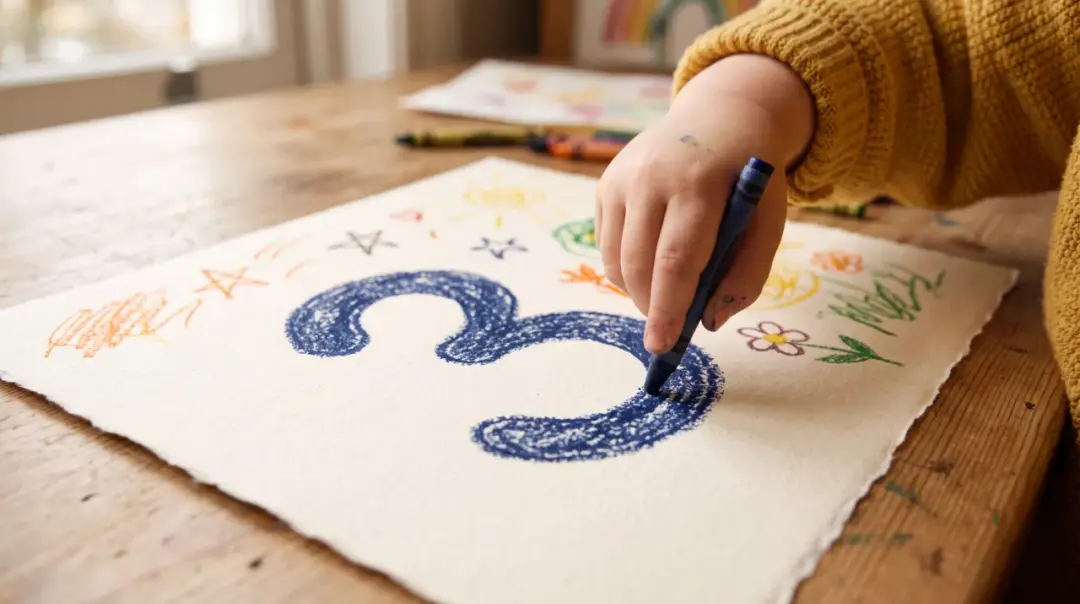
Recognizing digits usually runs ahead of writing them. A typical five-year-old points out most of 0 to 9 on a clock or a front door, while their own written digits are big, wobbly and sometimes mirrored. Reversals — a backwards 3, an E-shaped 5 — are a normal part of learning to write, common up to about age seven, and on their own they are not a warning sign; we cover why in why kids write numbers backwards.
If your child shows interest in making numbers, our guide to teaching a child to write numbers starts from the easy straight-line digits. If they show no interest yet, that is also normal at five — hands are often a step behind eyes.
More, fewer, the same: comparing
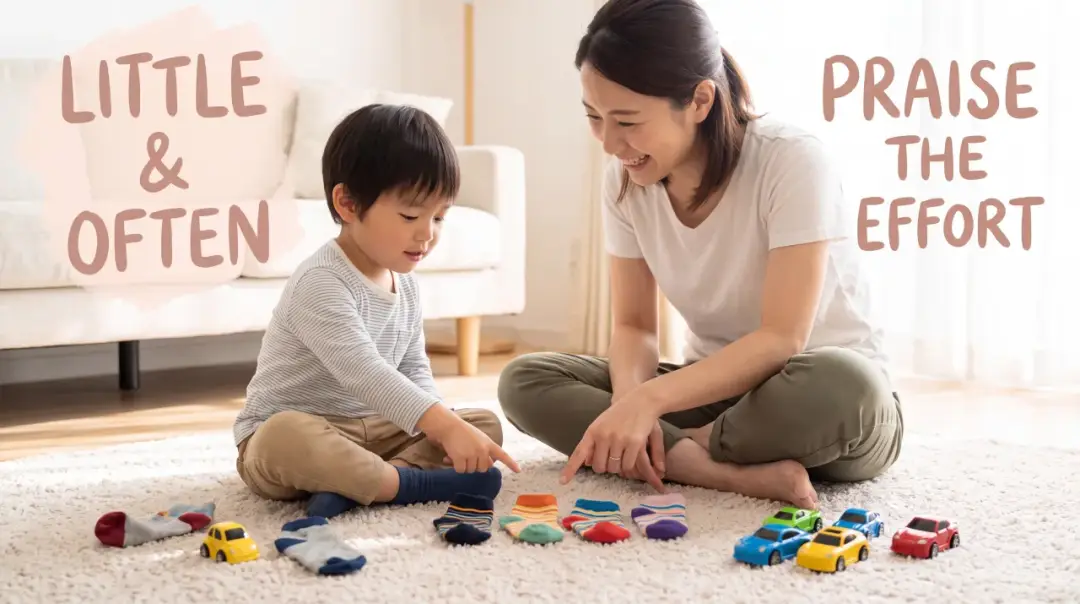
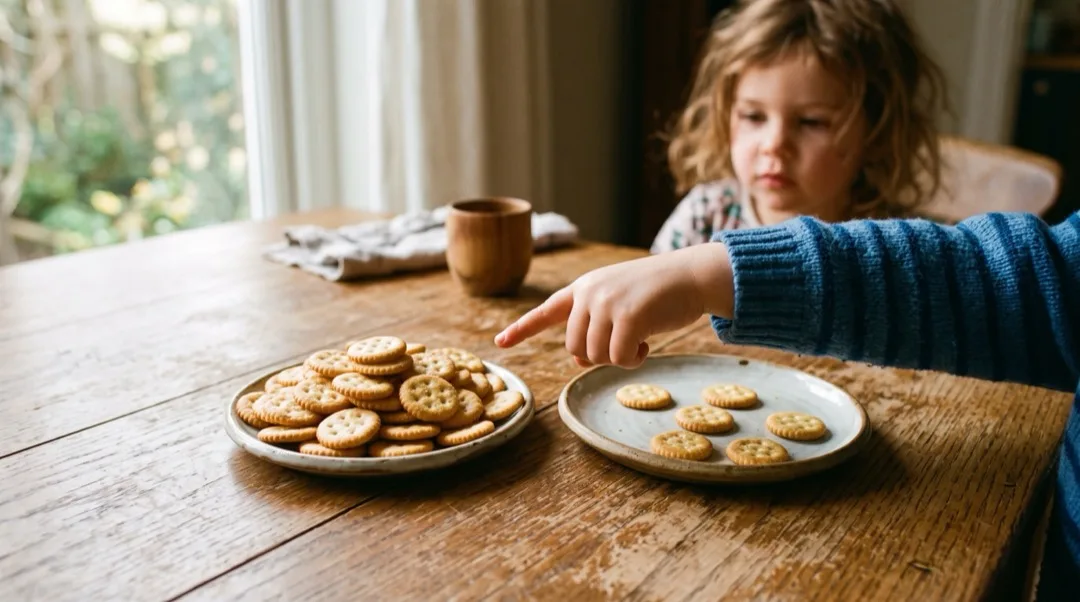
Comparing is the quiet milestone parents overlook because it does not sound like math. It is. A five-year-old who glances at two plates and announces the unfairness of cookie distribution is doing real number work: judging quantities, and — when the plates are close — counting to settle the argument. Sharing things out "one for you, one for me", and words like more, fewer and the same, are exactly the foundation later arithmetic sits on.
Shapes, patterns and the rest of it
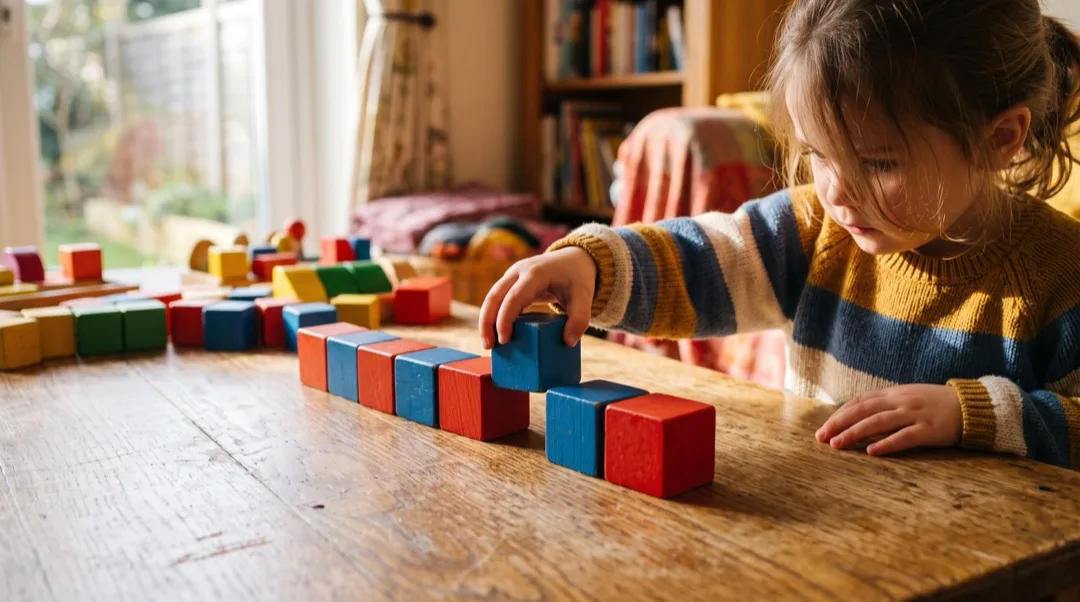
The non-counting corner of early math is easy to tick off in normal play: naming circles, squares and triangles; continuing a simple pattern (red, blue, red, blue…); sorting a muddle of buttons by color or size; position words like behind, under, next to; and comparison words like taller, heavier, full. None of this needs teaching in any formal sense — it needs blocks, a sock drawer and someone to talk to.
Milestones at 4, 5 and 6 — one honest table
Treat every cell as the middle of a wide, normal range — children hit these a year early or a year late without it meaning much:
| Skill | Around 4 | Around 5 | Around 6 |
|---|---|---|---|
| Saying numbers | To 10, with skips | To 10–20, teens wobbly | To 100, decade jumps |
| Counting objects | 3–5, one touch each | Up to about 10 | 10–20 and beyond |
| Recognizing digits | A few familiar ones | Most of 0–9 | All digits, teen numbers |
| Writing digits | First big attempts | Several, reversals common | Most digits, tidier |
| Comparing | "More" by sight | More/fewer for small groups | Counts to compare |
| Adding & taking away | With objects, tiny amounts | On fingers, within 5 | Small sums in the head |
If you want the same honesty for the years after this table, the milestone guides for counting to 100 and times tables pick up where age six leaves off.
What NOT to worry about at five
- Backwards digits. Normal to about seven, and not a dyslexia sign on their own.
- Counting on fingers. Fingers are a number line a child carries everywhere. Let them.
- Skipped teens. "…twelve, fourteen, fifteen" — the teens are the worst-named numbers in English. They arrive late for almost everyone.
- Counting an object twice. One-to-one correspondence is a skill, not a given; it firms up with play, not correction.
- Zero interest in worksheets. A five-year-old who refuses a worksheet but counts every step on the stairs is doing fine. The stairs are the curriculum.
- Being "behind" a friend. The spread at five is enormous and says almost nothing about who is "good at math" at ten.
When it is worth asking someone
A few things are worth a calm conversation rather than a worry spiral: a five-year-old who shows no interest in counting anything, ever; who cannot tell which of two obviously different piles has more; who loses skills they used to have; or whose frustration around numbers looks like distress rather than boredom. The first stop is their teacher, who sees the whole class and knows what the range really looks like. For general development questions, the CDC's Learn the Signs. Act Early. milestones and your pediatrician or GP are the calm, reputable route.
Where our app fits, honestly
Our app, 99 Math Animals, starts exactly at this age: counting small groups of animals and writing the answer with a finger, which pairs the two skills five-year-olds are growing — counting things and forming digits. It is not a readiness test and it will not tell you if your child is "on track"; no app can. If you are considering any math app for a five-year-old, our honest checklist for choosing one applies to ours too, and ways to practice numbers at home needs no screen at all.
Questions parents ask
What math should a 4-year-old know?
Typically: counting out loud to about 10 (with skips), counting 3 to 5 objects with one touch each, recognizing a few digits, naming basic shapes, and comparing obvious amounts by sight. Interest matters more than totals at four.
What math should a 6-year-old know?
Many six-year-olds recite toward 100, count and compare larger groups, read and write most digits, and add or subtract small amounts with fingers or objects. First grade builds fast on this, but the range stays wide and being mid-pack is not a problem.
Is my child behind in math?
At this age, almost certainly not in any way that predicts the future — the normal range at five spans more than a year. The signals worth a conversation are a total lack of interest in counting, trouble comparing obviously different amounts, or losing skills. Ask the teacher before you ask the internet.
Should a 5-year-old be able to write numbers?
Some can write several digits, many write a few wobbly, mirrored ones, and some are not there yet — all normal. Most children write recognizable numbers between 4 and 6. If they are keen, start with the straight-line digits like 1, 7 and 4.